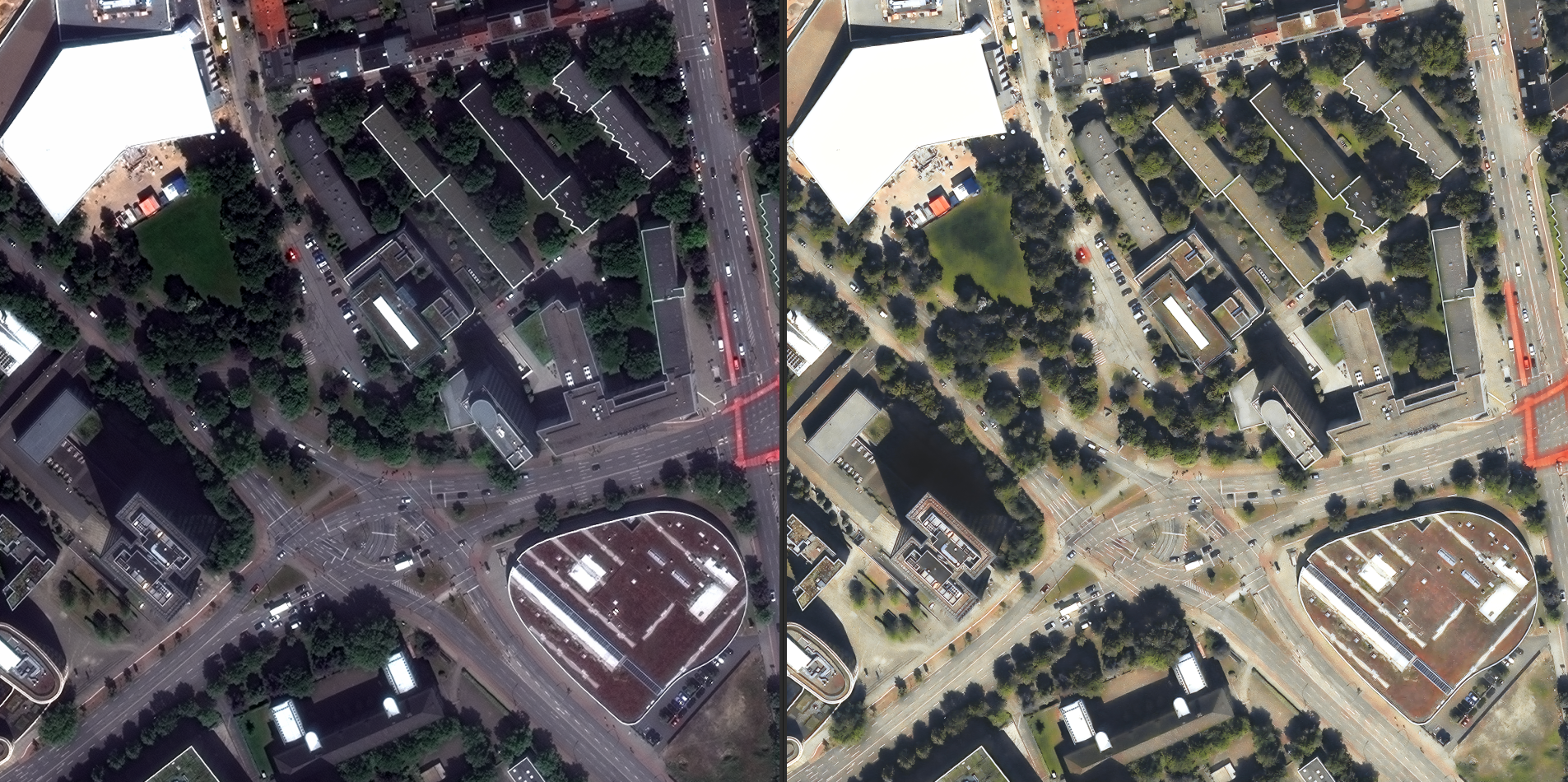
Building footprints are one of the most-requested geospatial layers — for cadastre, insurance, telecoms planning, population estimates and the base of every 3D city model. Drawing them by hand does not scale past a neighbourhood. Here is how we extract millions of them, accurately, from imagery.
Detection, then geometry
A deep segmentation model finds building pixels across the whole scene. The hard part is what comes next: turning fuzzy raster blobs into the clean, straight-edged polygons a GIS expects. Our regularisation step squares up corners, aligns parallel walls and removes the staircase artefacts that naive vectorisation produces.
Keeping quality high at scale
- Tiling with overlap so buildings on tile edges are not cut in half.
- Confidence scores on every polygon, so low-certainty areas can be flagged for review.
- Consistent attributes — area, perimeter, centroid — computed the same way everywhere.
- Change-aware updates so re-running over a new capture only touches what changed.
The footprints export as GeoJSON, Shapefile or directly into our WebGIS, and they double as the input to LoD2 building models. One extraction, many products.