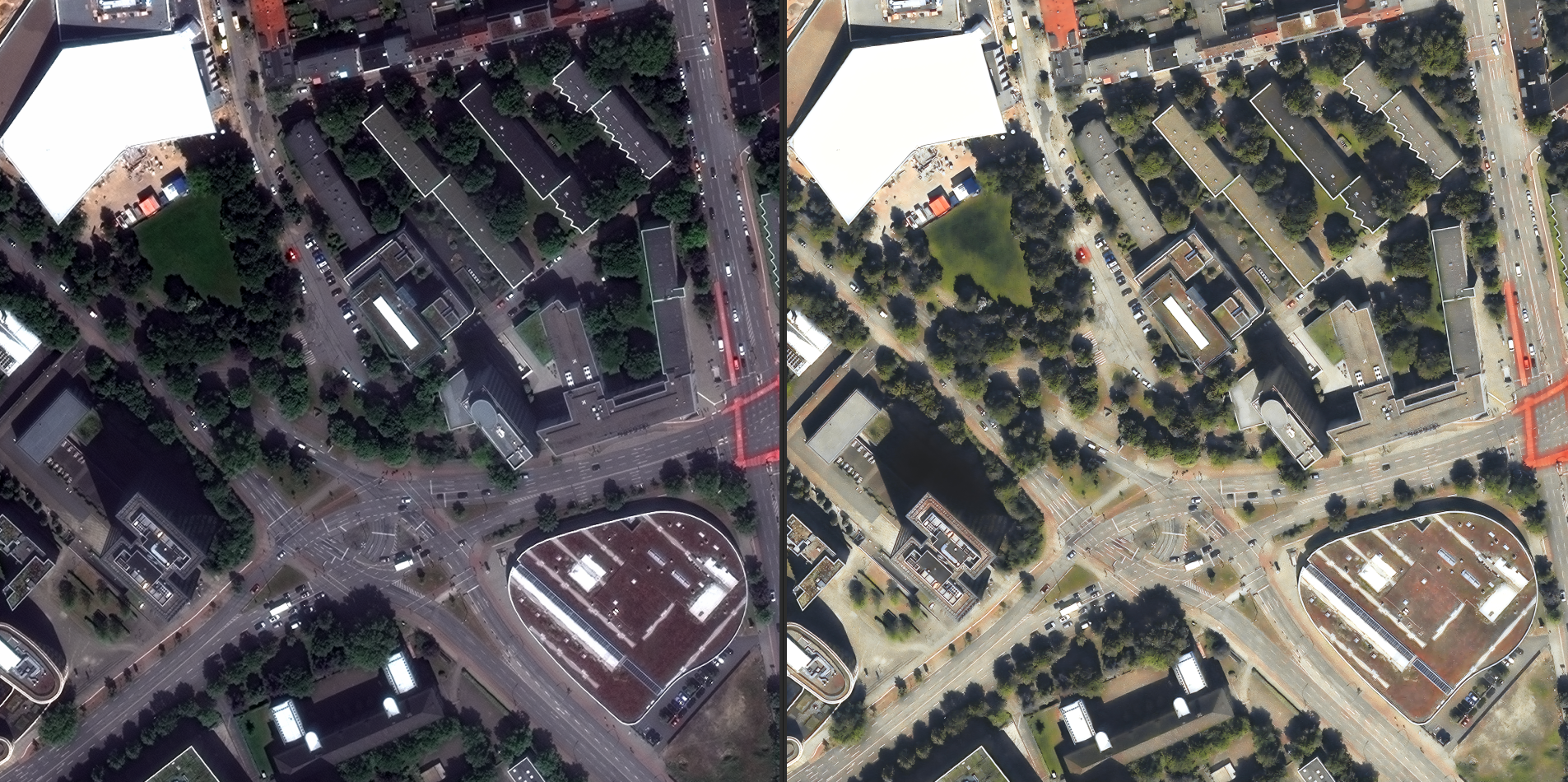
We applied one consistent pipeline across 17 Japanese cities — Tokyo, Chiba, Osaka, Nabari, Sapporo, Tokushima, Nagoya, Fukuoka, Kamakura, Kikuchi, Saitama, Kobe, Hiroshima, Yokohama, Sasaguri, Omata and Sendai — extracting and classifying polygon and polyline features enriched with quality and status attributes.
The challenge
National programmes need comparability: the same classes, the same accuracy and the same attributes, city after city, so analysis holds together across the whole country rather than stopping at each municipal boundary.
Our approach
Our models extracted a rich feature set with consistent semantics, including:
- buildings (including semi-rigid structures such as industrial sheds and warehouses);
- median strips as area polygons, and the sidewalk / non-sidewalk and road / non-road boundaries;
- elevated roads over water (bridges) and over land (viaducts).
Features carry status attributes — for example occluded (partially or fully hidden) and quasi-side (adjacent to an ambiguous or unmarked edge) — so the data is quality-aware out of the box.
Results & benefits
- Comparable land-cover and road-infrastructure layers across 17 cities under one legend.
- Polygon and polyline features ready for national- and regional-scale GIS.